
Scale more easily with just one monthly charge per seat for all your IT support. Our Gold Coast managed services cover everything from hardware and phones to cyber security and data resilience.

22+
years in business
200+
clients
15+
professionals
I want to protect my data from cyber threats.
I want fast, reliable IT support.
Onboard new staff, manage endpoints, and keep your software running at its best. That includes application patching and 24/7 device monitoring.
Shield against cyberthreats with both active and passive defences. We’ll work with you to achieve Essential Eight Maturity Level 2 – the recommended security standard for Gold Coast SMBs.
Deploy, manage, and back up your Gold Coast business’s cloud environment. We’ll help keep your infrastructure secure and your costs down.
Connect to business NBN – then maintain that connection through continuous monitoring, AI-powered firewalls, and secure network design.
Even with the best cyber security, critical incidents can happen. Give your business the resilience it needs to quickly recover through best-practice backup management and disaster recovery planning.
Set up and manage landline, VoIP and PBX telephony. Add video and messaging capabilities to help your people work seamlessly – no matter where they’re based.
Give your people the IT support they need to do their jobs efficiently. Your tickets, calls and emails go directly to our in-house technicians – which means faster problem resolution and no support desk ping pong.
‘IT Leaders are THE IT professionals for business.
We have used their services for many years for our entire office needs and they have always been prompt, professional and reliable.
They have also provided solutions for networking and storage problems which turned out to be simple and cost effective as opposed to other advice we received which would have cost us much, much more. I highly recommend them.’

Bruce Nelson
Zakazukha, the Gold Coast
Most IT problems shouldn’t be problems.
But they evolve from risks to issues because MSPs fail to take the initiative.
As your IT support partner, we don’t wait for tickets to float downstream to us.
We’ll come to you with recommendations that improve security and productivity ahead of time – which means less risk, less downtime, and better outcomes for your business.
Talk through your business’s current IT with one of our Gold Coast-based solutions advisers.
They’ll explain the benefits you can expect when you switch to IT Leaders.
One of our technicians audits your current IT environment.
We’ll propose a solution that includes every product and service you need with monthly, per-user pricing.
Changing IT providers isn’t like it used to be.
Most of our clients switch to us with fewer than 5 minutes of downtime.
Change can be that easy.
Helping Queensland brands take control
since 2003.
Not every business needs local IT support.
But, when on-site hardware breaks or networks need to be configured or you want to meet face to face with the people responsible for your business’s tech health, having a Gold Coast-based partner matters.
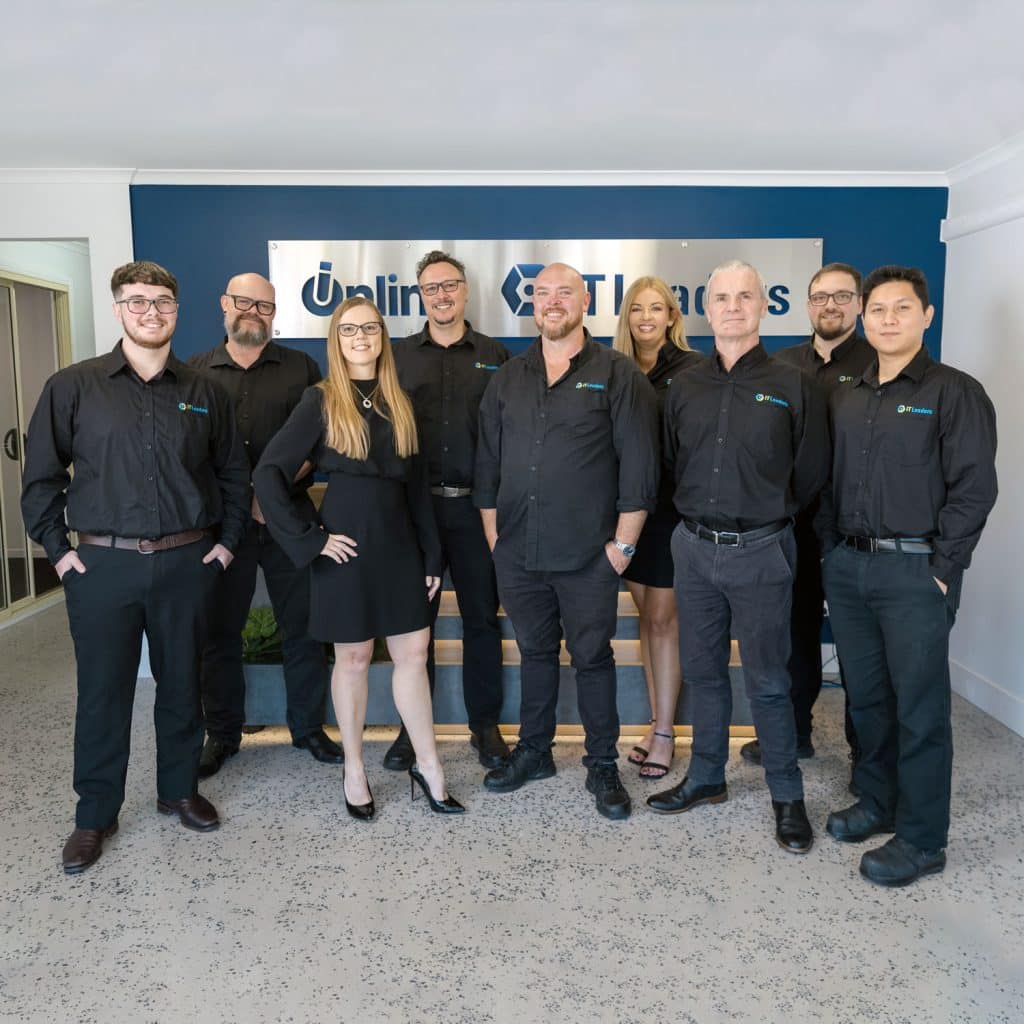
Our team operates out of our office on Lawrence Drive, Nerang – the same location we’ve been working from since 2016.
‘I have always been really impressed with the service I've received from IT Leaders. Josh and Anette have done a great job supporting our IT needs and Josh in particular has helped me time and time again for months.
I highly recommend their services to anyone who needs reliable and friendly IT support services for their business.’
Stuart Rogers
International Outsourcing Group
Most of our managed IT services are bundled together in a monthly per-user charge. That makes it easier for you to understand how your IT costs correlate to your headcount, which is ideal if your business is in the process of scaling or rightsizing.
Some IT costs, like your internet charges, are charged by site or usage instead. Those are grouped separately on your monthly invoice.
Ad hoc service fees – for real-time technician support, for example, or setting up new users – are charged on an hourly basis. We do our best to minimise the number of support requests your team needs to lodge through a combination of proactive troubleshooting and clear, easy-to-use resources. (Many MSPs have vague or missing documentation, which means their clients need to pay support costs to do basic tasks like password resets and permission changes.)
When your team encounters an IT issue, the simplest way to solve it is to escalate it through your MSP’s support hierarchy. Most hierarchies have 5 levels or tiers.
Most Gold Coast MSPs charge between $200 and $300 an hour for ad hoc IT support. The exact cost depends on the support level you need, whether you request support during business hours, and whether you need on-site assistance.
Yes, our support team are available 24 hours a day, 365 days a year. Keep in mind that additional fees and charges may apply for out-of-hours service.
Yes, it does. Keep in mind that, depending on your location, on-site callouts may attract an additional service charge.
The terms ‘IT support’ and ‘managed IT’ are used interchangeably by most MSPs. Managed IT means that your MSP continuously manages some or all of your business’s IT function, which can include everything from device monitoring to patch management and cyber security. It’s different to break–fix services (when you engage an IT provider to solve a specific problem) and project work (when you hire an IT vendor to run a limited-scope project like a cloud migration).


